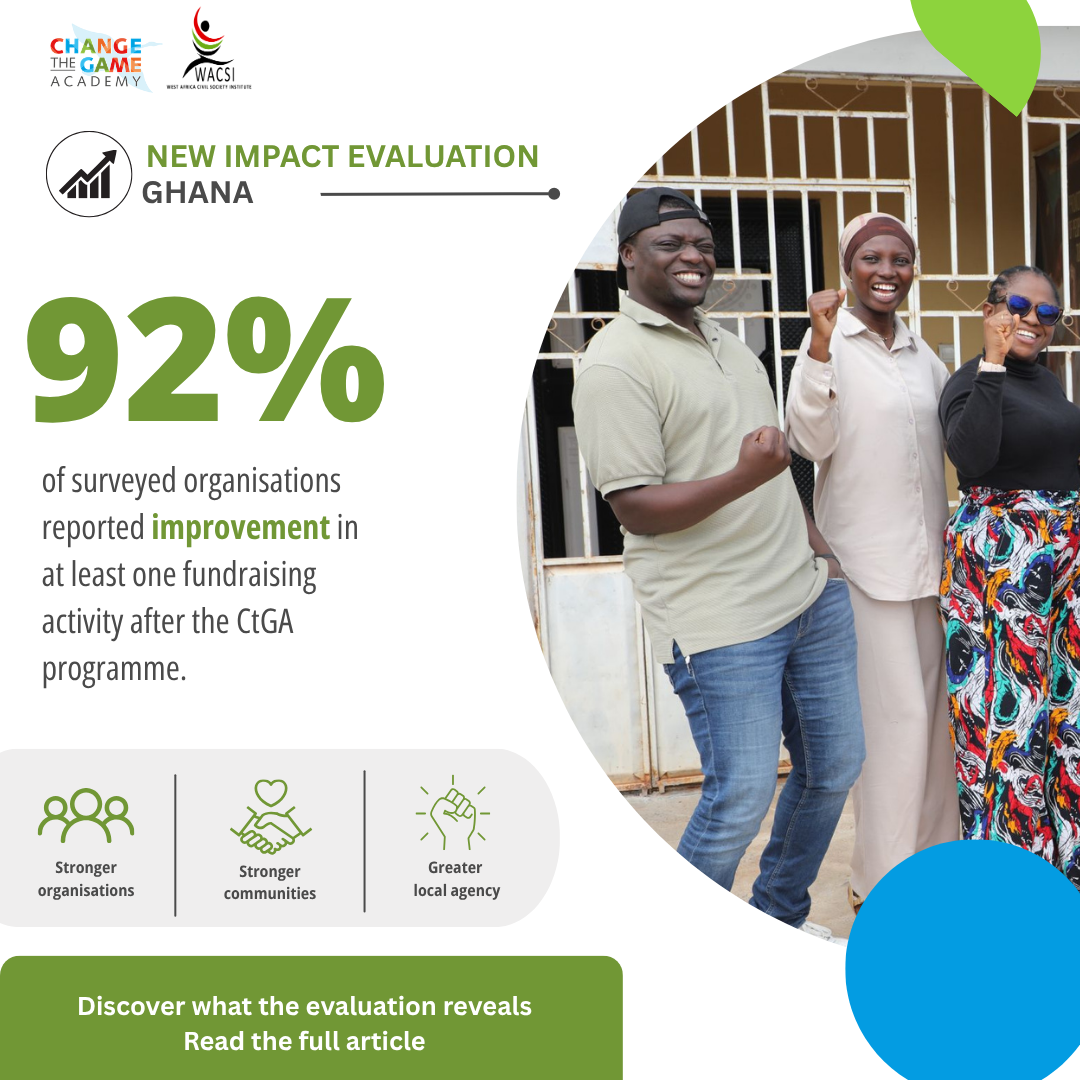


A new evaluation of the Change the Game Academy programme in Ghana suggests that participating organisations are strengthening local fundraising practices, mobilising more in-kind support, and engaging more strategically with communities and decision-makers.
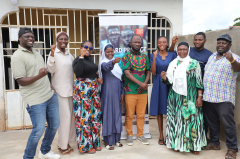
Evaluation points to reported improvements in local fundraising, stakeholder engagement, and organisational confidence among CtGA trained civil society organisations in Ghana.
An impact evaluation of the Change the Game Academy programme in Ghana suggests that participating civil society organisations have reported improvements in local fundraising, stakeholder engagement, and organisational confidence after taking part in the training. The evaluation looked at the contribution of two core CtGA training areas: Local Fundraising and Mobilising Support. It combined survey responses from participating organisations with focus group discussions, case studies, and qualitative analysis to understand how the programme may have supported organisational sustainability and advocacy practice.
Commissioned by the West Africa Civil Society Institute (WACSI), the evaluation covers nine cohorts and over 79 organisations trained since 2017. Of the organisations that responded to the evaluation survey, 92% reported improvement in at least one fundraising activity after the programme. Separatedly, 27 CSOs reported collectively raising $315,000 in new funds since the programme, averaging $ 11,667 per organisation. . Beyond the numbers, the report documents a broader shift in how organisations describe their approach to sustainability. Several participating organisations reported moving away from heavy dependence on international donors and towards more community-driven models, while also expanding their advocacy reach and deepened engagement with policymakers, traditional leaders, local businesses and community stakeholders.
A new perspective on local resources and organisational practices
One of the clearest findings of the evaluation is that the Local Fundraising training appears to have helped organisations rethink how they identify and mobilise resources. Rather than seeing funding mainly as something that comes from outside, participating organisations reported paying closer attention to resources already present in their communities. These included individual donations, in-kind contributions, sponsorships, crowdfunding, volunteer time, local business support, and relationships with traditional and community leaders.
Among the organisations that reported on their fundraising activities, 77% showed improvement in cash fundraising and 85% showed improvement in in-kind contributions after the CtGA training. The share of reporting organisations raising more than $20,000 annually in cash increased from 4% before the training to 24% after the training. In-kind support also grew: the share of organisations raising $5,000 - $10,000 annually in in-kind contributions increased from 4% to 35%. Participants also reported changes in confidence, communication, proposal writing, brand visibility, and their ability to approach local donors and partners. Taken together, these figures suggest that local fundraising can become a relevant pathway to sustainability when organisations have practical tools, stronger confidence, and clearer strategies.
The evaluation also indicates that the programme may have supported broader organisational change. Participants described improvements in strategic planning, internal operations, stakeholder engagement, and the way they communicate their work. In several cases, organisations reported moving from informal or reactive fundraising efforts to more structured approaches, including fundraising teams, fundraising plans, improved marketing tools, and clearer engagement strategies.
“The real value of local fundraising is not only the money raised. It is the trust, visibility and ownership that organisations build when communities, local leaders and businesses become part of the solution”, highlights Melissa Juisi Simo, CtGA trainer.
Alongside these reported organisational changes, participants expressed a highly positive view of the CtGA programme. The evaluation recorded an average sentiment score of +0.82 on a scale ranging from −1 for negative sentiment to +1 for positive sentiment. Participants described the training as practical, relevant and useful for their work. They particularly valued the participatory training model, the follow-up support provided by WACSI and the professional network created through the programme. For many, the programme was not only a technical training opportunity, but also a space for connection, encouragement and shared learning among civil society actors facing similar challenges.
Stronger advocacy and stakeholder engagement
The Mobilising Support component also appears to have contributed to more strategic engagement with stakeholders. According to the evaluation, organisations reported increases in activities such as stakeholder events, media engagement, sensitisation campaigns, and contributions to policy processes.
Organisations also reported deeper engagement with government institutions, traditional authorities, community leaders, and private sector actors. “This matters because many civil society organisations do not only need funding to sustain their work; they also need influence, relationships, and the ability to engage decision-makers around the issues affecting their communities.
By strengthening advocacy capacity, the programme may have supported organisations to move beyond service delivery alone. It contributed to their ability to act as civic actors, mobilise communities, build alliances, and participate in more accountable local development processes”, highlights Melissa Juisi Simo, a Change the Game Academy trainer.
Local resources, lasting change
The WACSI-CtGA impact evaluation suggests that Local Fundraising and Mobilising Support can contribute to stronger foundations of civil society work in Ghana.
At a time when many civil society organisations are navigating shrinking donor funding and increasing pressure to demonstrate sustainability, the CtGA approach offers a practical pathway. It helps organisations look inward and outward at the same time: inward to strengthen their own systems and confidence, and outward to mobilise the communities, relationships, and local resources that can sustain their work.
The most important shift described in the evaluation is not only financial; it is strategic. Participating organisations reported moving from dependency to greater agency, from waiting for external support to recognising that communities themselves hold resources, influence, and power for change.
Read the full report here: https://wacsi.org/building-self-reliance-in-csos-and-cbos-impact-evaluation-of-wacsi-ctga-programme/