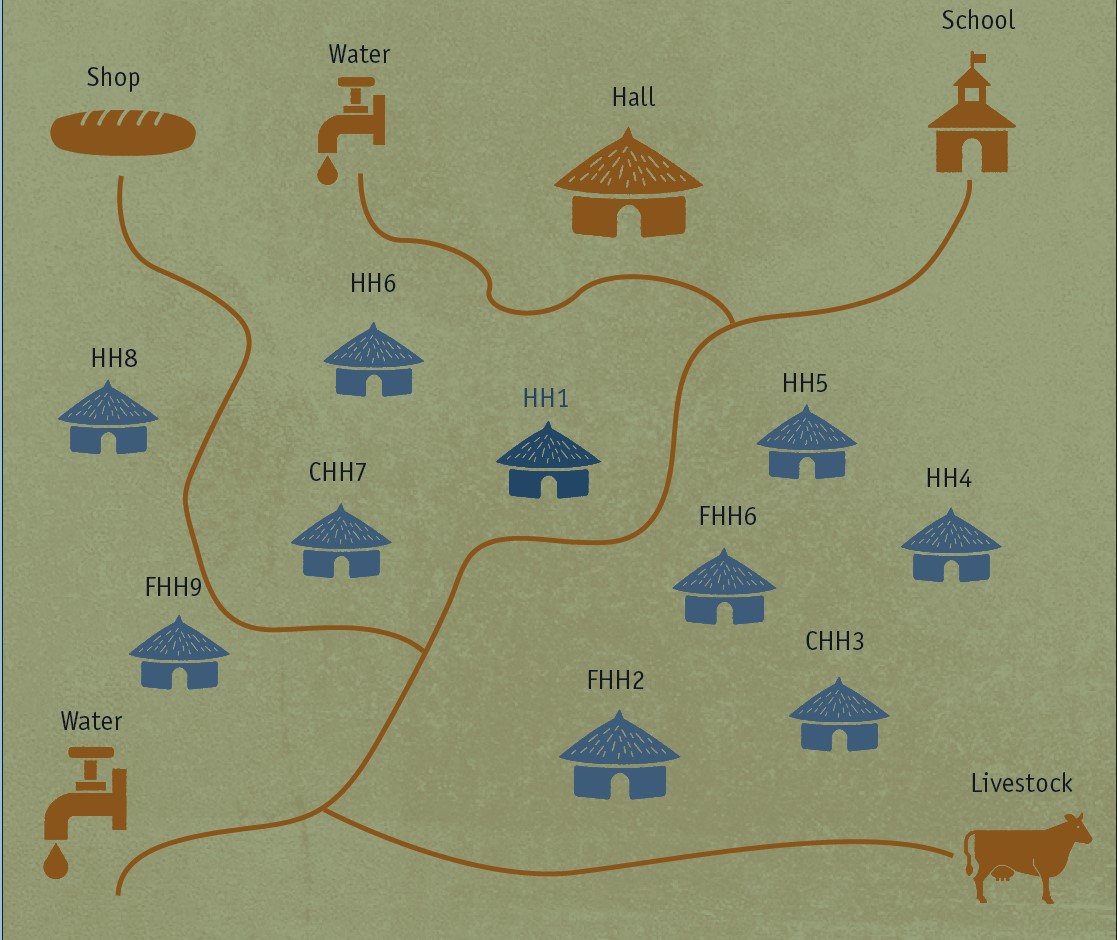


How to facilitate the development of a social map?
STEP 1: Introduce the tool to the community
Inform the community you wish to conduct a social map with them. That your organization needs to understand how the different HHs survive and exist in the community. This contributes to a better understanding of the community and its needs and issues.
STEP 2: Explain what will be done
In order to gain this understanding, a facilitator should draw a social map together with a community group of maximum 6 people, gender balanced as well as age balanced. The group will plot a sample of HHs, indicating each HH’s name. (Remember that the community’s definition/understanding of what a HH will apply.)
Check with the community whether mapping exercises have been implemented before and what their experience of it was.
It will not be possible to draw all the HHs; only a sample. The sample depends on the number of HHs in the community, but usually not more than 50 HHs will be drawn; in a smaller area, 20 to 30 HHs only. If there are only 20 HHs in an area, all 20 HHs can be drawn.
Explain the sampling procedure to them by using the example of cooking rice. In order to taste if the rice requires salt, one does not eat the whole pot as it is cooking but only takes a bite to determine if more salt is required.
The HHs from this sample will be grouped into categories of well-being [e.g. from most to least vulnerable, or from poorest to richest]. A representation from each category will then be interviewed.
STEP 3: Drawing the map
Ask someone from the group to draw her/his HH (on a sheet of paper, on a cement floor or in the sand) and writetheir name next to the HH and number it (1, 2, 3, 4, etc.).
From the position of this person’s house, let the group draw any key features in the village/community: school, cemetery, roads, paths, water points, shops, etc.
Ask the person to add her/his immediate neighbors (HHs) with their names; the others should help him/her recall names and positions of HHs.
Let the person continue adding HHs until there are about 30 to 40 HHs (depending on the size of the community).
Ask questions about each HH and use keys (see step 4) to note the information on the map. Once agreement within the group is reached on these details, record the discussion in notebooks.
Once all the HHs on the map have been dealt with, checkfor any gaps or additions from the group.
Example social map: