

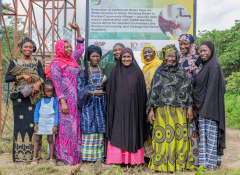
In Rumba Village, The Gambia, a training exercise became much more than a learning activity. Through community mobilisation, local leadership, and shared responsibility, residents helped turn a long-standing water challenge into a sustainable solution now serving over 600 people. This story shows how practical training can lead to concrete change when communities are not treated as beneficiaries, but as decision-makers.
When a training becomes a water system
A community in The Gambia turned training into action, mobilising local resources to build a sustainable water solution for over 600 people.
For years, access to clean and reliable water was a daily struggle in Rumba Village. Families spent hours securing water for basic needs, with the burden falling mostly on women and young people. Existing infrastructure could not keep up with the needs of the growing population, affecting health, hygiene, and everyday life. Everyone knew the problem. What wasn’t clear was how to solve it.
A turning point came through a Mobilising Support training conducted by CASA Gambia. As part of the training, organisations were challenged to move beyond theory and develop practical plans based on real community priorities. Rumba Village was selected as a case study, but what started as a learning exercise quickly became something more. CASA Gambia, Mama Africa for Gambia Foundation, and the Village Development Committee worked together to take the idea forward, from planning to implementation.
Through direct engagement with community members, local leaders, women, and youth, one priority stood out: access to water. Instead of starting with a donor proposal, the process began with the people most affected. Together, they mapped the situation, agreed on a way forward, and mobilised resources from multiple sources, including contributions from the community itself.
From mobilisation to measurable results
The outcome was tangible: a water extension system was installed, now serving over 600 people across 60 households. Around 36% of the total resources came from within the community, through financial and in-kind contributions. Once completed, the system was handed over to the Village Development Committee, ensuring local management and continuity.
What changed goes beyond the infrastructure; the process shifted how the community approached the problem. Instead of waiting for external funding, local actors mobilised their own networks, resources, and capacities to respond to a shared need. As Gibou Jobe from CASA Gambia explains: “Involving the community is central for sustainability. When people take ownership, they can continue the project even after funding ends.”
“The community didn’t just participate; it played a crucial role from assessment to implementation. They were not just beneficiaries, but decision-makers. They helped shape decisions, contributed resources, and stayed involved from beginning to end”, adds Lamarana Jallow from Mama Africa for Gambia Foundation.
The Rumba experience is not only about access to water. It shows what becomes possible when communities take the lead in solving their own challenges. By mobilising part of the resources locally and taking responsibility for the process, they built more than a system; they built ownership.
What started as a training exercise became a concrete example of community-led development, where knowledge translated into action, and action into lasting change.