

Stage 3: Developing the community’s Score Card
Step 1: Generate issues
After inputs have been identified and tracked, groups need to share ideas about service related issues to be reviewed. Elicit issues by asking questions like, “How are things going with service or programme here? What service or programme works well? What does not work well?” etc. Note all the issues generated by groups on flipchart paper and in your notebook, BUT only when a group has agreed on which issues they want listed. Help groups cluster similar issues. For all problems, ask for suggestions about how to improve the delivery; and for all strong points, discuss how to maintain them.
Step 2: Prioritise issues
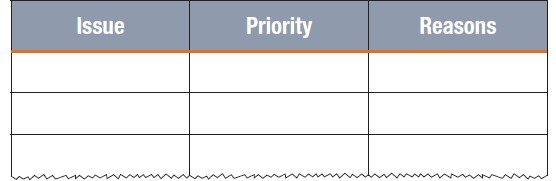
Often there are quite a number of issues generated, and not all are relevant to your service or project. Ask the group to agree on the most important and urgent relevant issues to deal with first. Let the groups give reasons for their choice. Use the following matrix:
Step 3: Close first meeting
After prioritisation has been done, reconvene as a big community group, and thank the community for their time and inputs. Explain that you will now take the information (general issues generated by all the groups) back with you to the office to develop indicators for the high priority issues and agree on a date for the follow up visit when the issues (to be presented as indicators) will be scored. Make it clear that the same groups with the same people need to be available for the scoring exercise.
Step 4: Develop indicators
Back at the office, facilitation teams need to meet and share the various issues generated by their respective groups. Here you will mix issues from the different groups (men, women, leadership and youth) to come up with common issues representing that location or area. Identify the major issues and from those, develop indicators and list the issues related to each indicator under it.
How to develop indicators
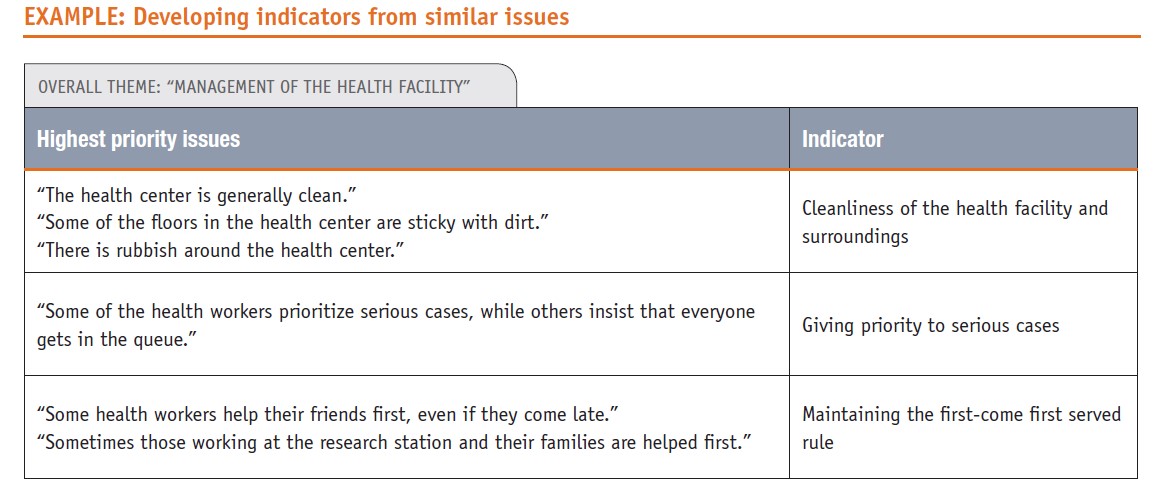
After general issues have been noted, identify the highest priority issues and group those that are similar. Then develop a single indictor that reflects the issue group e.g. indicators concerning center cleanliness, management of the services, delivery of the service, etc. Note that some indicators may fall under a general "theme”, such as management of the health facility, or dialogue and collaboration between health workers and communities.
Step 5: Develop a matrix for scoring
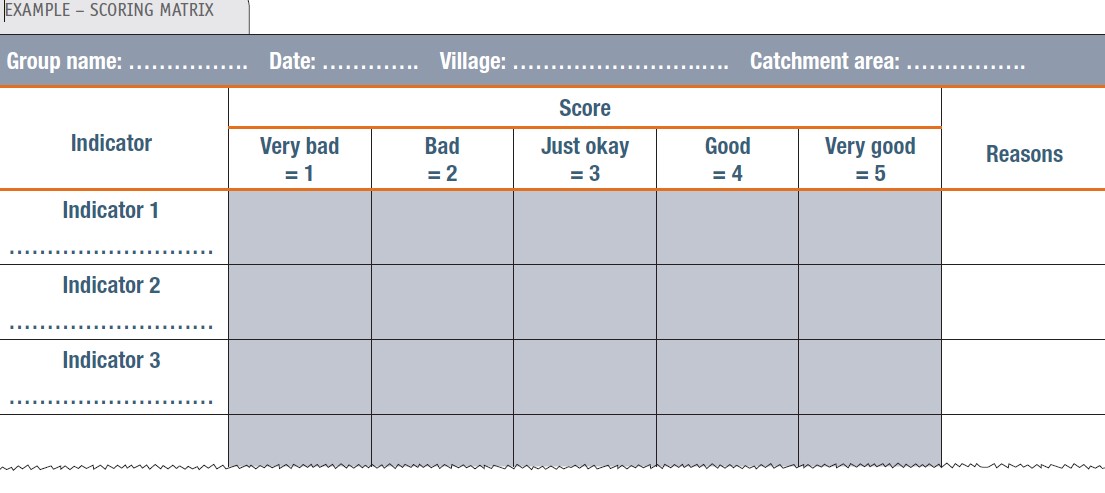
After generating the indicators, develop a matrix (“the Community Score Card matrix”) for scoring the indicators. Make copies to give to each of the focus groups when you next meet with them for the scoring. See the example of a scoring matrix below (for scoring purposes, it is usually easier to give higher numbers for better performance).